

Digitally recording, analysing and simulating value streams
Initial question and objective
How can processes in production, logistics or service be represented in such a way that they are not only transparent but can also be reliably evaluated when dependencies between process steps, fluctuations in times or quantities, and disruptions play a role?
Value stream analysis between established standard and limitations
Value stream analysis is an established lean tool for the structured recording of processes along the value chain. It helps to clearly present material and information flows and to visualise key performance indicators such as throughput times, inventories, utilisation rates and process quality. In its classic application, however, value stream analysis primarily provides a static snapshot. Dynamic effects such as variability, interactions between processes or temporal developments can only be represented to a limited extent.
Digital value stream creation with SimVSM
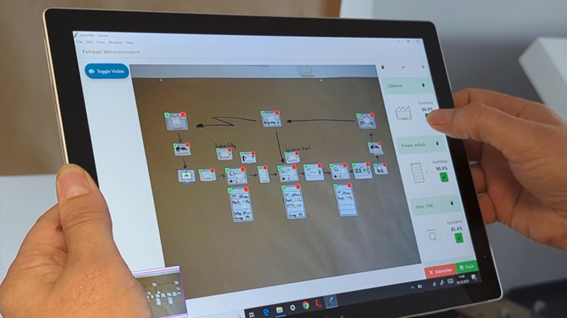
In this online webinar, we present the SimVSM app and show how value streams can be digitally recorded, modelled and analysed on a tablet or desktop. The app-based drag & drop modelling allows for a quick and intuitive introduction. Processes, material flows and key figures are mapped directly in the digital value stream, so that initial evaluations can already be made during modelling. Static key figures are immediately available in the model and support a well-founded analysis of the current situation.
Analysis and evaluation directly in the model
The digital value stream representation allows key figures to be analysed in context within the model. Throughput times, inventories or utilisation rates are not viewed in isolation, but are visible in their context. This allows weak points, bottlenecks or potential to be systematically identified and comprehensively evaluated.
Simulation for mapping dynamic effects
In addition, we provide an in-depth insight into SimVSM Pro and the use of simulation. With the help of random and disturbance variables, we show how processes behave over time and what effects fluctuations have on throughput times, inventories or delivery capability. Simulation allows dynamic effects to be explicitly taken into account and their influence on the overall system to be examined.
Comparison of scenarios and derivation of improvements
Based on the simulation, alternative scenarios and improvement options can be compared realistically. The results provide a quantitative basis for evaluating measures and preparing decisions in a structured manner.
Webinar content
- Digital recording and modelling of value streams with SimVSM
- Key figure-based analysis directly in the value stream model
- Use of simulation to examine dynamic effects and interactions
- Derivation of improvement approaches based on reliable results
Organisational information
Date: 3 March 2026, 3:00 p.m. to 4:00 p.m. (CET)
Language: English
Target audience
The webinar is aimed at specialists and managers from production, logistics and service who want to further develop value stream analyses digitally and evaluate processes on a more analytically sound basis.