
Value Stream Mapping

Improving Process Control in Production and Service
Value Stream Mapping
Improving Process Control in Production and Service

Value Stream Analysis: Definition, Method & Digital Implementation

Value stream analysis is a tried-and-tested lean management method for the systematic
optimisation of production and logistics processes. It visualises the entire
value stream of a product – from raw material procurement to delivery – and
systematically identifies waste, bottlenecks and opportunities for improvement.

Traditional value stream mapping is typically carried out using pen and paper.
However, this method has its limitations: it cannot depict dynamic interactions
between processes. Digital value stream mapping using
simulation software overcomes this limitation – different scenarios can be tested before
they are implemented in practice.

On this page, we explain the method, provide practical examples and show you how to
successfully introduce value stream mapping into your organisation.

Further reading


What information does a classic value stream analysis provide?

The classic method provides initial key figures and indications of:

  • Waiting times and inventories
  • Incorrect planning specifications, e.g. processing times
  • Quality or delivery problems
  • Missing information or data

It thus provides a solid basis for process optimisation – but usually remains static and two-dimensional.

What are the limitations of the classic method?

A classic value stream analysis cannot map dynamic interactions between processes.

For example, it is not possible to examine how

  • different buffer sizes,
  • set-up times or
  • variant diversity

affect the overall material flow and productivity.

This is where pen and paper reach their limits – and where the digital solution comes into play.
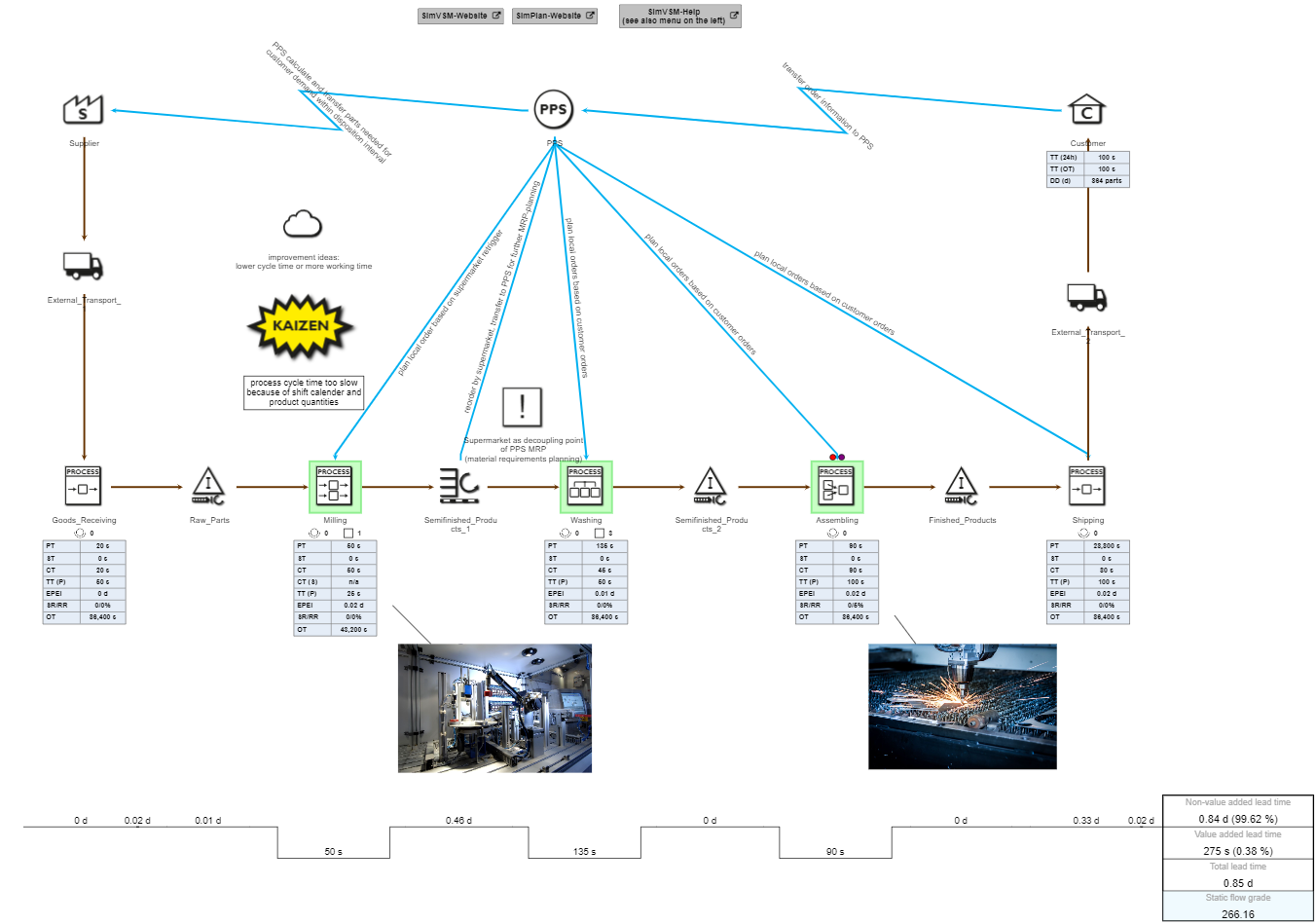
Value stream analysis overview

Would you like to learn about the classic method step by step? Our practical guide to value stream mapping takes you through all five steps, from start to implementation.

How does SimVSM expand on classic value stream analysis?

SimVSM makes value stream analysis digital, flexible and interactive. The app allows you to create and edit value streams directly on a tablet and enrich them with key figures – without any programming or simulation knowledge.

The most important advantages:

  • Quick adaptation: Processes are modelled using drag-and-drop and can be changed at any time.
  • Real-time collaboration: Teams work on the same model simultaneously – regardless of location and transparently.
  • Automatic calculations: Key figures such as throughput times, inventories or cycle times are determined automatically.
  • Simulation included: Process variants can be tested and compared directly in order to make informed decisions.
  • Easy documentation: Results can be exported as images, PDFs or vector graphics and used for reports.

This turns classic analysis into a digital twin of the value stream that not only describes but also actively reveals optimisation potential.

See how other companies have gone about it: In our practical case studies, we present three anonymised case studies from the mechanical engineering, logistics and automotive supply sectors, featuring real results.

Why simulation is the decisive step

With SimVSM’s integrated simulation interface, process parameters can be changed and their effects calculated immediately.

The results are available within seconds – visualised in clear diagrams and key figures.

This turns every value stream analysis into a measurable experiment that provides a real basis for decisions on improvement measures.

How does SimVSM support the continuous improvement process (CIP)?

In many companies, value stream analysis is part of the continuous improvement process. With SimVSM, this approach can be consistently continued digitally. Processes can not only be recorded once, but also regularly reviewed and further developed. By directly comparing different versions of a value stream, teams can immediately see which measures have measurable effects.

The combination of analysis, simulation and documentation in one system significantly reduces the effort required – while at the same time increasing transparency throughout the entire life cycle of a process. This makes SimVSM a central tool for lean management, process optimisation and data-based decisions in production and the service sector.

SimVSM also supports audit evidence: changes are traceable, responsibilities are documented, KPIs are comparable – audit-proof and cross-team.

Learn more

Learn more about the range of functions offered by SimVSM.

Convince yourself of SimVSM!

Sign Up
for Our Newsletter

Stay up to date with the latest
in simulation technology!

15585